Welcome
Welcome to this blog
 Kristine Kathryn Rusch****Miles Flint has just returned from a cruise of the outer reaches of the solar system, a cruise he needed after the Disty crisis. Within minutes of his return he received a desperate plea for help from his mentor, Paloma. He rushed to her condo only to find that she had been murdered.
How, why, and by whom constitutes the mystery that Flint must unravel.
Once again the writing is taut, full of verisimilitude, and effective at creating a believable world with believable characters. It has been a long time since science fiction has captured my imagination the way this series has. I'm reminded a little of the Master and Commander series by Patrick O'Brian. Both series create believable, compelling characters who grow and change from book to book. At the same time their worlds are full of interesting twists and turns with unexpected but thoughtful quirks. I'll probably end up buying the whole series.
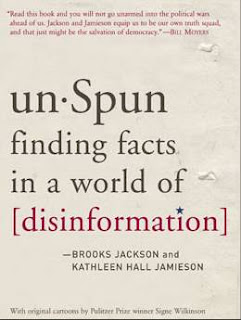 Brooks Jackson and Kathleen Hall Jamieson*****If I were a political operative, I would be dismayed by this book because it lays out for the reader all the tools used by spin-masters in simple, accessible language. Chapter by chapter, the authors explain the indicators and techniques of spin, and our receptiveness to them. For example, the second chapter lists these indicators:
- If its scary be wary
- A story that's too good
- The dangling comparative
- The superlative swindle
- The "pay you Tuesday" con
- The blame game
- Glittering generalities
The next chapter exposes the tricks of spin which match up nicely with the indicators explained in the preceding chapter. The clarity and simplicity with which this is presented makes unSpun unusally valuable and practical. Here is a list of the tricks:- Misnomers
- "Frame it and Claim it"
- Weasel words
- Eye candy
- The average bear
- The baseline bluff
- The literally true falsehood
- The implied falsehood
The authors supply plenty of examples for each trick and explain how the spin is crafted.But what is it about people that makes them vulnerable to spin? The authors answer that question in chapter four. In short we let language do our thinking for us, have partisan biases, are susceptible to vivid individual examples, can be fooled by our feeling of being right, and -- surprise, surprise -- engage in wishful thinking.So what can do in the face of these handicaps? The authors supply very practical suggestions in their next two chapters listing mental disciplines and reliable Internet web sites -- including FactCheck.org. This would be a great text for a High School civics class but is a good read for all ages.
 Kristine Kathryn Rusch****
This is my second "Recovery Artist" novel and I'm afraid I'm hooked. Recovery Man is a better book, but this one was pretty good as well. Rusch's series is a kind of thought experiment concerning multi-culturalism; the role of networked information and database technologies in a world of reduced privacy, advanced bio-tech; and impersonal, unjust law (at least by human standards). This last is what makes the retrieval artists necessary.
The main conflict in the story is between the Disty, an inscrutible alien race, whose customs and beliefs are very foreign to human understanding, and human customs and beliefs. Disty beliefs and rituals concerning death generate behavior that is "virus like" Beliefs about "contamination" and burials lead to behavior that is irrational by human standards, and deadly for both races.
Miles Flint saves the day with sophisticated search techniques that uncover the solution to "decontaminating" some burials on Mars. The plot is fairly tight, the characterization fully developed, and the evocation on a future world well done. This is a good series.
 The World at the End of TimeFrederik Pohl-*Most of the books I read are pretty good. Every now and then I find a book that I just don't want to read after I've gotten it home from the library. Nothing wrong with those books necessarily, they just don't strike my interests at the time. More rarely I start a book and read it to the end, wishing it would end sooner. By definition they can never end soon enough.That was the case with this book. Pohl would sucker me along with some interesting scientific explanations held weakly together by an over complicated picaresque plot, suspended in a goo of wordy exposition and dialog. Pohl has the reputation of being a good story teller, and I can see glimpses of that in this book.Plot: Earth sends interstellar colonists to far away planet. Un-beknownst to puny earthlings, mighty sociopathic, paranoid star-being is hanging out in the area, afraid that copies he has made of himself are out to get him (Reasonable since they are copies -- so clever!) So he blows up stars where he thinks they live. But he doesn't get all of them. What to do? Send cluster of decoy stars and planets off to edge of universe, causing time dilation. Puny earthlings have colonized one of the planets in cluster, so off they go too! Silly earthlings never figure out what happened only that they are traveling with a cluster of stars near the speed of light. Meanwhile our hero, Victor, gets frozen and thawed out many times to accommodate the story's conceit. Poor Victor, things change. World freezes too. Thaws. Third time he thaws, people really different, have evolved into long, skinny beings from living in orbit (Hmmm . . . LeMark lives!). Becomes sex slave. Misses wife. Goes back to planet. Nothing living even though environment can support it. But super technology works for thousands of years keeping people frozen as "corpsicles." Victor realizes the universe is done except for the last cluster of stars. Star being realizes that too, is on his way ... when the book ends.You can take it from there. The physics science seems like it is based on real physics. Cloning, environmental science seems poorly conceived.There are probably three good books in this one. But the one needed serious editing. I wonder if his contract called for 400 pages (It's 407, so I'm suspicious.) Anyway, don't read it. That's supposed to be a minus star rating under the author name.
 The Ghost Map: The Story of London's Most Terrifying Epidemic--and How It Changed Science, Cities, and the Modern WorldSteven Johnson
****
This is a good, but uneven book. Does a nice job of describing the thinking and methodology of John Snow, the first to suspect cholera was transmitted via water, and the contribution of Henry Whitehead, a local clergyman to the Soho district where the outbreak occured. Snow's mix of inventiveness, observation, and mapping are clearly presented within historical context, and well done. Snow's work was given fine granular information from Whitehead's deep familiarity with the families struck by the disease, creating an argument that finally triumphed over the "miasma" disease paradigm that held sway at the time. The conclusion of the book went on to argue the benefits of urbanization as a "greener" solution to population growth than rural or suburban living patterns. He then goes off into speculation about plagues and terrorism as limits to urbanization. It's true that solving the disease problem in cities has led to their continued growth, but the conclusion felt like a classic student essay where the writer starts a new topic as a conclusion instead of truly wrapping up the old one.
 Einstein: His Life and Universe
Walter Issacson
***
A good read. Interesting details about early relationship with wife and family. He and his first wife had a daughter whom they later gave up for adoption, something no other biographies had revealed. More of a bohemian than I realized. Einstein never really collaborated in a deep way and, once he came up with his main ideas, became fixed on them.
 Augustus: The Life of Rome's First Emperor
Anthony Everitt
***
A fast moving account of Augustus's unlikely rise to power. Interesting elements:
- soldiers and citizens had allegiance to generals/leaders and not to state
- constant drive for top honors and unbridled competition between individuals prolonged Roman civil wars
- issues were rarely ideological between factions other than status differentiation between senate/aristocracy and commoners (and that wasn't even so simple)
- Augustus's determination to keep power in family led to it's dissolution (Tiberius renouncing role for TEN years)
- better understanding of Cleopatra and Anthony's alliance
 Union 1812: The Americans Who Fought the Second War of Independence
A. J. Langguth
***
Having Read Gary Will's Henry Adams and the Making of America this was a good review for me and told via the biographies of the main characters. Wasn't as clear about Napoleon's machinations to force America into war with Britain, but a great retelling of the conflict between Napoleon and his brothers over the wisdom of selling Louisiana (He was in the bath and forcefully told them to bug off!)
 Henry Adams and the Making of America
Garry Wills
****
It's been a while since I read this, but it's essentially a summary and commentary of Adam's history of the US during Jefferson, Madison. Monroe presidencies. It gave me a much better understanding of world politics vis a vis the US during this period.
 The Palace of the Snow Queen: Winter Travels in Lapland
**
I read this book more for information to see what a little of my daughter's time in Sweden might be like. It's a very interesting part of the world with a complex and unusual society of Sami, Norwegian, Finnish, and Swedish cultures brewing together. Change is coming to the North and this book benchmarks the present with a good presentation of the past as well. That being said, the writing was good but not great. Pace was a little slow.

